Still Running Through Shin Pain? Here Is When You Need to Stop.
Shin pain is one of the most common complaints among runners and active people — and one of the most commonly ignored. Pushing through a bad run is one thing. Pushing through the wrong kind of shin pain is something else entirely.
What Are Shin Splints, Exactly?
The term "shin splints" is commonly used to describe pain along the inner edge of the shinbone (tibia). Medically, this is often referred to as medial tibial stress syndrome, or MTSS. It tends to develop when repetitive load on the lower leg exceeds what the bone and surrounding tissue can comfortably absorb.
It is most common in runners, but also shows up in dancers, team sport athletes, military recruits, and anyone who has recently increased their activity levels. The pain is typically described as a dull ache along the shin that comes on during or after exercise, and often eases with rest — at least initially.
Worth knowing: Shin splints exist on a spectrum. In milder cases, they respond well to load management and some basic changes. In more serious cases, they can progress into a stress reaction or stress fracture — which is a different problem that needs to be handled very differently.
The Signs That Tell You to Stop Running
Most people know what general shin soreness feels like after a big week of training. What is harder to recognise is when that soreness has shifted into something that needs actual attention.
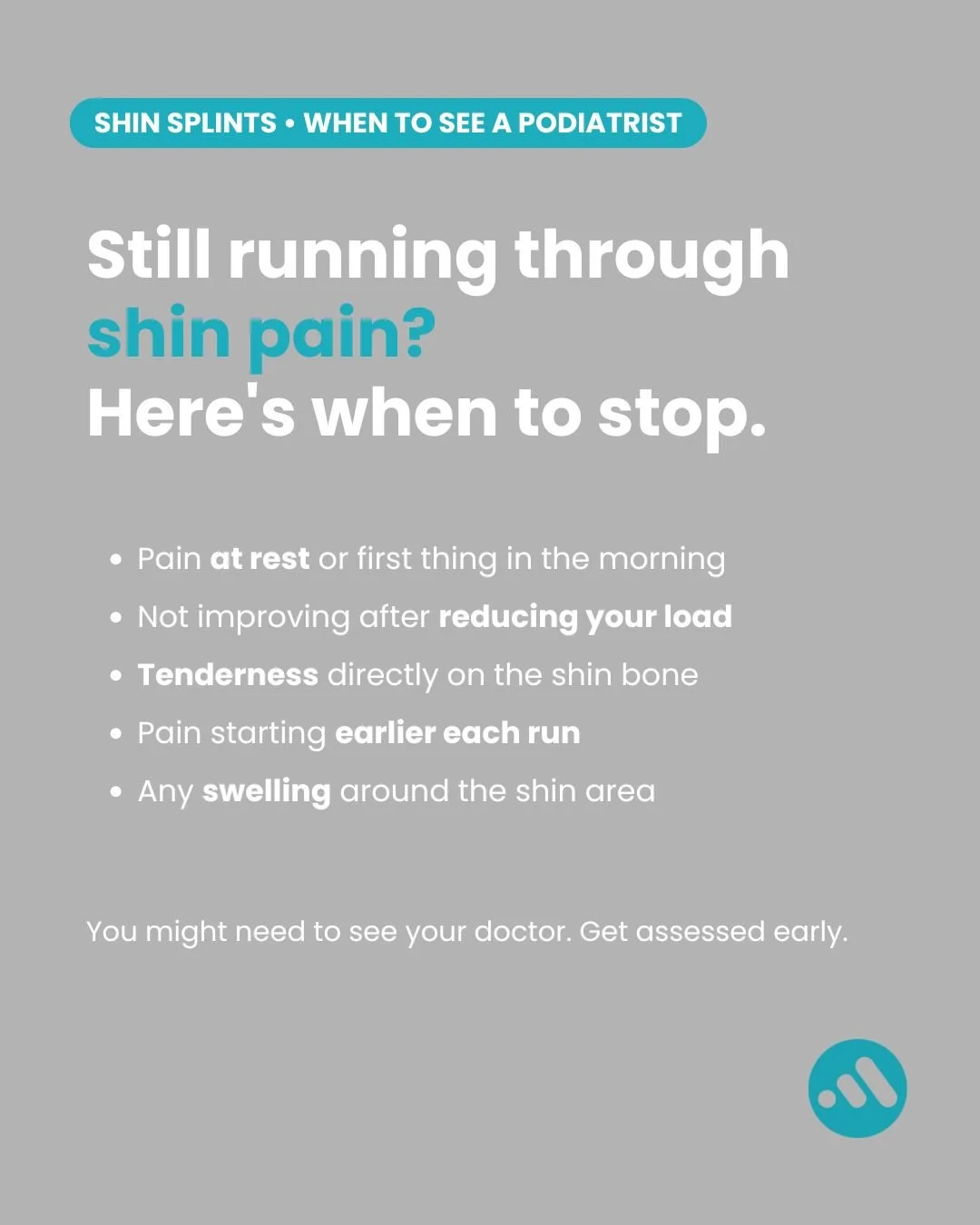
These are the signs that suggest it is time to pull back and get assessed:
Pain at rest or first thing in the morning
Shin pain that shows up when you are not doing anything — sitting, lying down, or when you first wake up — is a meaningful change. Discomfort during or after exercise is common. Discomfort at rest is not something to brush off, and may suggest the tissue is under more stress than usual loading would explain.
Pain that is not improving after reducing your load
If you have already backed off your training and the pain is still there, that is important information. Typical shin soreness tends to settle fairly quickly when load is reduced. Pain that persists despite rest is a reason to get a proper assessment rather than continuing to wait it out.
Tenderness directly on the shin bone
There is a difference between generalised soreness in the lower leg and tenderness that is pinpoint and located directly on the bone itself. If pressing on a specific spot along your tibia produces sharp or localised pain, that warrants attention. This pattern is sometimes associated with stress reactions, which sit further along the injury spectrum than typical shin splints.
Pain that starts earlier each run
If your shin pain used to kick in at kilometre eight and now it is showing up at kilometre two, that progression is a clear signal. When pain is arriving sooner and sooner despite no increase in training, the tissue is not recovering between sessions the way it should be.
Any swelling around the shin area
Swelling in the lower leg around the shin is not a normal feature of garden-variety shin splints. If you notice any visible puffiness, warmth, or swelling — particularly if it is asymmetrical — get it looked at. It does not necessarily mean something serious, but it does mean something else may be going on.
Why Pushing Through Is Risky
There is a reason podiatrists and sports medicine clinicians take shin pain seriously: the progression from shin splints to stress reaction to stress fracture is real, and it happens more often than people expect.
A stress fracture of the tibia requires a much longer period of time off than a case of shin splints caught early. And in some cases, depending on the location and severity, management becomes significantly more involved. Early assessment almost always leads to better outcomes and a faster return to what you enjoy doing.
The honest truth: Running through shin pain is not always catastrophic. But it is a gamble, and the odds get worse the longer the warning signs are ignored.
What Can Actually Cause Shin Splints?
Shin splints are rarely a one-cause problem. A few factors that are commonly associated with their development include:
A sudden increase in training volume or intensity — particularly common at the start of a new running block or after a break
Running on harder surfaces or changing terrain
Footwear that is worn out or not suited to your foot type or gait
Biomechanical factors — such as how your foot strikes the ground, your arch type, or how your hip and knee move during running
Muscle weakness or tightness in the calf, hip, or foot
Inadequate recovery between training sessions
Most cases involve a combination of these rather than a single clear cause. That is also why a proper assessment — one that looks at your load history, biomechanics, and footwear — tends to be more useful than generic advice.
What a Podiatry Assessment Looks Like
If you come in to Foot Faults with shin pain, the assessment will generally look at:
Your training history and recent changes in load
How your foot and lower limb move — both in isolation and during walking or running
Your footwear and whether it is suited to your foot type
Where the tenderness is located and what that suggests about the nature of the injury
Whether imaging is needed to get a clearer picture
From there, management is tailored to what is actually driving the problem. That might include load modification, a footwear recommendation, a referral for imaging, orthotic support, or a combination of approaches.
A Word on Imaging
Not every case of shin pain needs imaging. For straightforward presentations, a clinical assessment is often enough to get a clear sense of what is going on and put a sensible plan in place.
However, if there are features that suggest a stress reaction or fracture may be involved — such as pinpoint bony tenderness, pain at rest, or a pattern that is not responding as expected — imaging such as an MRI or bone scan may be recommended. Your podiatrist or GP can guide you on whether this is warranted.
The Takeaway
Shin pain is common. But common does not mean harmless, and it definitely does not mean you should keep running through it without understanding what you are dealing with.
If you are noticing any of the warning signs above — pain at rest, tenderness on the bone, pain arriving earlier in your runs, or swelling — it is worth getting assessed sooner rather than later. A short pause now is almost always better than a longer one down the track.
Our team at Foot Faults assesses and manages shin pain and running-related lower limb injuries regularly. If you are unsure what is going on with your shins, we are happy to take a look and give you a clear picture.
Book an appointment at Foot Faults
We have four clinic locations that you may visit. Our podiatrists assess and treat a wide range of foot and lower limb conditions.
footfaults.com.au | Book online or call us at 07 3343 9430
Related Topics:
Heel Pain | Plantar Fasciitis | Footwear Assessment